


Hugging Face
Hugging Face hosts 2M+ open models plus datasets and Spaces demos, with PRO, Team and Enterprise plans and pay-as-you-go GPUs.
Sign in to rate this tool.
Overview
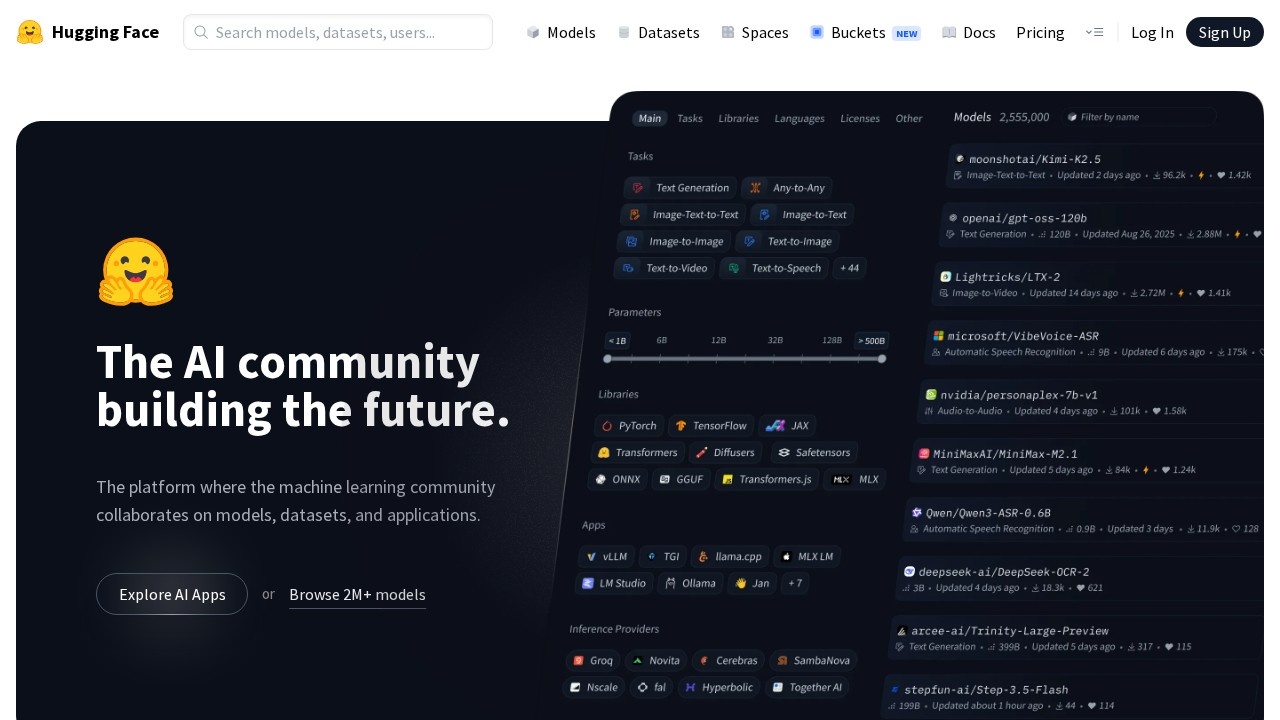
Hugging Face is where much of the machine learning world shares its work. The Hub hosts more than 2 million models, along with datasets and Spaces, which are small apps and demos that run in the browser. Many labs publish open model weights here; the trending list during our check included new releases from DeepSeek, Google and others.
It isn't a single AI tool so much as infrastructure. Developers use it to find and download models, version their own models and datasets with Git-style repositories, try demos, and read papers through Daily Papers. There's also HuggingChat, a chat interface for open models.
Paid products
Browsing and downloading public models is free. The paid side, from the official pricing page (checked October 2026):
- PRO account, $9/month: 10× private storage, 2× public storage, $2 of inference credits each month, 8× ZeroGPU quota with top queue priority, and the Dataset Viewer on private datasets.
- Team, $20 per user/month: SSO (SAML and OIDC), storage regions for data location, audit logs, resource groups for access control and usage analytics. All members get PRO benefits for ZeroGPU and Inference Providers.
- Enterprise, from $50 per user/month: the highest storage, bandwidth and API rate limits, plus enterprise support.
Compute is billed separately. Spaces can run on free CPU hardware or on upgraded GPUs billed by the hour, and Inference Endpoints, which deploy a model on dedicated autoscaling infrastructure, start at $0.033 an hour. Inference Providers offer API access to models served by partner providers. Hugging Face also offers community GPU grants for side projects.
Who needs it
ML engineers, researchers and developers building on open models. If you just want a chatbot, this isn't the place to start. If you want to compare open models, fine-tune one or ship a demo, it's close to unavoidable.
Pros: huge free catalogue of models and datasets; low-cost PRO tier; pay-as-you-go GPUs without a cloud contract.
Cons: model quality and licences vary from repo to repo, so read each model card; costs for endpoints and GPUs add up if left running; the sheer volume can be overwhelming for beginners.
Alternatives
Google's Gemma models are one of many open families you'll find on the Hub. If you'd rather call a hosted model through a simple API, look at DeepSeek.
Details
- Pricing
- Freemium
- Release date
- 2026-08-17
- Last checked
- 20h ago
- Indexing
- index, follow
- Category
- ML
Suggest an edit
Sign in to suggest an edit.
Pros and cons
Pros
- huge free catalogue of models and datasets
- low-cost PRO tier
- pay-as-you-go GPUs without a cloud contract
Cons
- model quality and licences vary from repo to repo, so read each model card
- costs for endpoints and GPUs add up if left running
- the sheer volume can be overwhelming for beginners
Alternatives
 GemmaGemma is Google DeepMind's family of open-weight models, from phone-sized E2B and E4B up to 31B, plus variants for embeddings, translation and health.
 ReplitReplit is a browser-based builder where an AI Agent writes, hosts and publishes full apps from a plain-language description, with database and auth built in.
 Modal ComRather than chasing every possible feature, Modal Com picks the ones that matter and does them well. That restraint is noticeable the first time you open it. Freelancers use it...
 Kilo AIUnderneath it all, the processing is efficient enough for everyday use. Large inputs take a moment, but ordinary work flows through without interruption. Kilo AI brings a fresh take on...
 LakesailThe tool is free, which keeps the barrier to entry low. You can try it before deciding whether it earns a permanent place in your workflow. Built for ai marketing...
 v0 by Vercelv0 by Vercel generates full-stack web apps from prompts, syncs with GitHub and deploys to Vercel in one click, with per-model token pricing.
 ClineCline is an open-source coding agent for VS Code, the terminal, desktop and cloud that works with your choice of model provider and your own API keys.
 Quadratic MultiplayerBefore you decide, skip the speculation and look at the source. quadratichq.com shows exactly what Quadratic Multiplayer does today and how to get started with it. Plenty of detail is...
 MindstudioYou are not locked into a single way of doing things. Mindstudio supports your existing habits instead of forcing a new one, which makes adoption within a team much smoother....
 CerebriumIt is a practical choice for ai coding work, and the honest way to evaluate it is to give it a spin. Start at cerebrium.ai for the latest information. The...
 GitHub CopilotGitHub Copilot review (October 2026): AI coding assistant in your editor and on GitHub, verified Free, Pro, Pro+ and Max plans and AI Credits explained.
 Tensor.ArtTensor.Art is a free online image generator and model hosting site where you run community checkpoints and LoRAs or use guided tools like OC Creator.