


Qdrant Io
There is a deliberate calm to how Qdrant Io works. Loading screens are short, buttons do what they say, and your work is saved where you expect it to be....
Sign in to rate this tool.
Overview
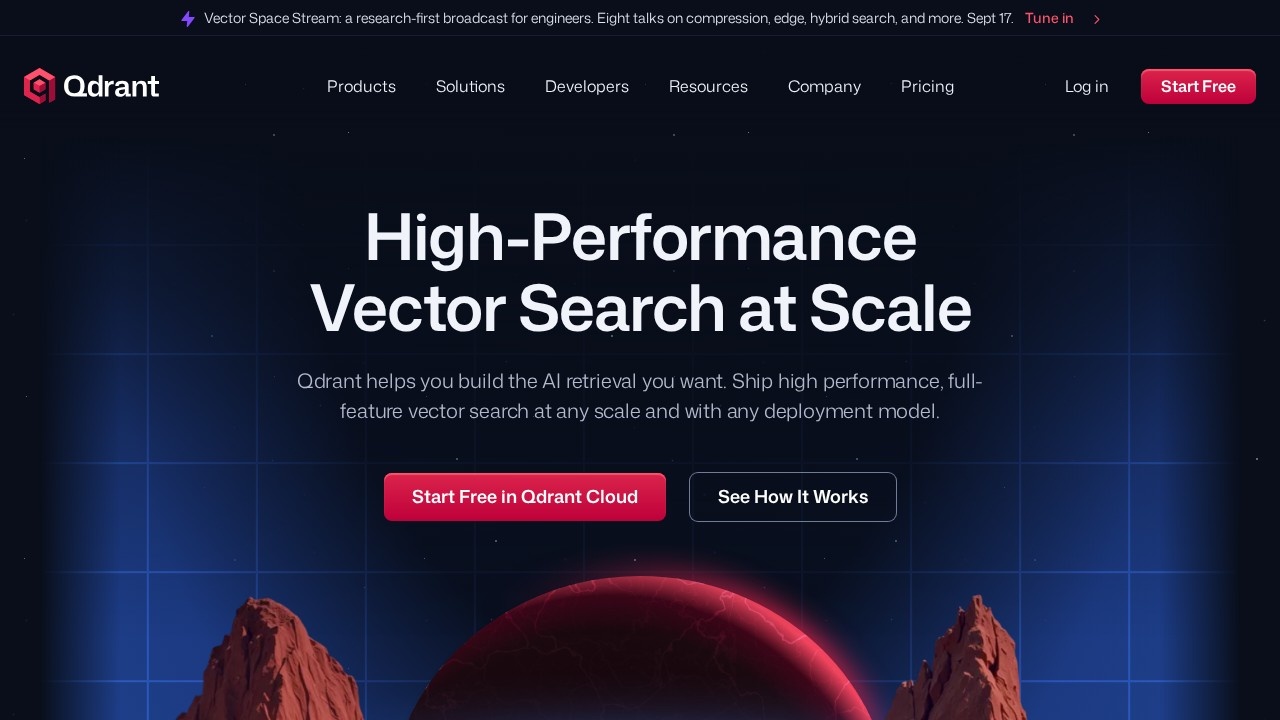
Qdrant is a high-performance vector search engine and database. It helps developers build the retrieval layer of AI applications, storing embeddings and finding the most similar items quickly at any scale and with any deployment model. It is open source and written in Rust, and the project has more than 35,000 GitHub stars and over 60,000 community members. Qdrant says it is SOC 2 and HIPAA compliant.
Use cases
Common uses include retrieval-augmented generation (RAG), recommendation systems, advanced search, data analysis and anomaly detection, and AI agents. Qdrant highlights industries such as ecommerce, legal tech, hospitality and travel, HR tech and healthcare tech.
Search features
You can store metadata as JSON and use advanced filters, including nested, text, geo and has_vector filters. Native hybrid search blends keyword and vector search in one query, supporting dense or sparse vectors with BM25, SPLADE++ and miniCOIL. Built-in multivector support lets you attach several vectors to one object, which makes retrieval more expressive and supports multimodal data. One-stage filtering applies filters during the search itself, rather than before or after, to keep results accurate and fast.
Deployment options
You can run the open-source engine yourself, or use Qdrant Cloud, a managed service with a free starting tier. Qdrant Hybrid Cloud runs in your own infrastructure with Qdrant management, and Qdrant Enterprise Solutions serve larger organisations. Qdrant Cloud Inference creates embeddings inside the platform, Qdrant Edge, in beta, brings vector search to edge devices, and Qdrant Serverless is listed as coming soon.
Developers
Documentation, a roadmap, changelog, certification, benchmarks, demos, a startup programme and a bug bounty programme are available. Guides cover security, observability, quantisation for reducing memory use, and resilience.
Pricing
You can start free in Qdrant Cloud, and the open-source version is free to self-host. Paid cloud pricing depends on resources used; see the pricing page.
Things to consider
Vector search requires choosing an embedding model and tuning chunking and filters for good results. Self-hosting means you handle backups, scaling and updates. Estimate memory needs for large collections before choosing a plan.
Teams often start with the free cloud tier or a local Docker container while prototyping, then move to a managed cluster or their own infrastructure as data and traffic grow, without changing their application code.
Details
- Pricing
- Freemium
- Release date
- 2025-08-07
- Last checked
- 4d ago
- Indexing
- index, follow
- Category
- Code
Suggest an edit
Sign in to suggest an edit.
Alternatives
 Applitools EyesIt runs on a free model, so getting started is a low-risk decision. After a few sessions you will know quickly whether it fits. Applitools Eyes brings a fresh take...
 CruderraIt is a practical choice for ai coding work, and the honest way to evaluate it is to give it a spin. Start at cruderra.com for the latest information. If...
 LitellmThe tool has been refined through real use. Settings, history, and templates are organized so repeat work takes less effort each time. Litellm brings a fresh take on ai education...
 CodefastAccording to its listing, Codefast is an AI tool in the ai...
 Page CanaryIt works well as a daily driver. Saved templates, recent history, and multiple output options mean the tool adapts to the way you actually work. For a straightforward look at...
 CosineCosine brings a fresh take on ai coding tools, pairing powerful AI with an interface that does not get in the way. It is aimed at everyday users and professionals...
 Granter AIWhat stands out most is predictability. The same input produces dependable output, which matters when you are producing work for clients or publishing on a schedule. Pricing is free, and...
 Chat University V1Collaboration hooks are there too - simple ways to pass work between teammates without emailing files back and forth or losing track of versions. You will find a free plan,...
 BeamFor a straightforward look at an option like this, Beam is a sensible place to start. Visit getbeam.ai to see live examples and up-to-date details. The feature set covers the...
 ReplitReplit is a browser-based builder where an AI Agent writes, hosts and publishes full apps from a plain-language description, with database and auth built in.
 v0 by Vercelv0 by Vercel generates full-stack web apps from prompts, syncs with GitHub and deploys to Vercel in one click, with per-model token pricing.
 Js2tsRather than chasing every possible feature, Js2ts picks the ones that matter and does them well. That restraint is noticeable the first time you open it. For a straightforward look...