

Kaedim
If ai image generation tasks are part of your routine, Kaedim is worth testing against your own use cases. Their website, kaedim3d.com, has the full details. The flexibility shows when...
Sign in to rate this tool.
Overview
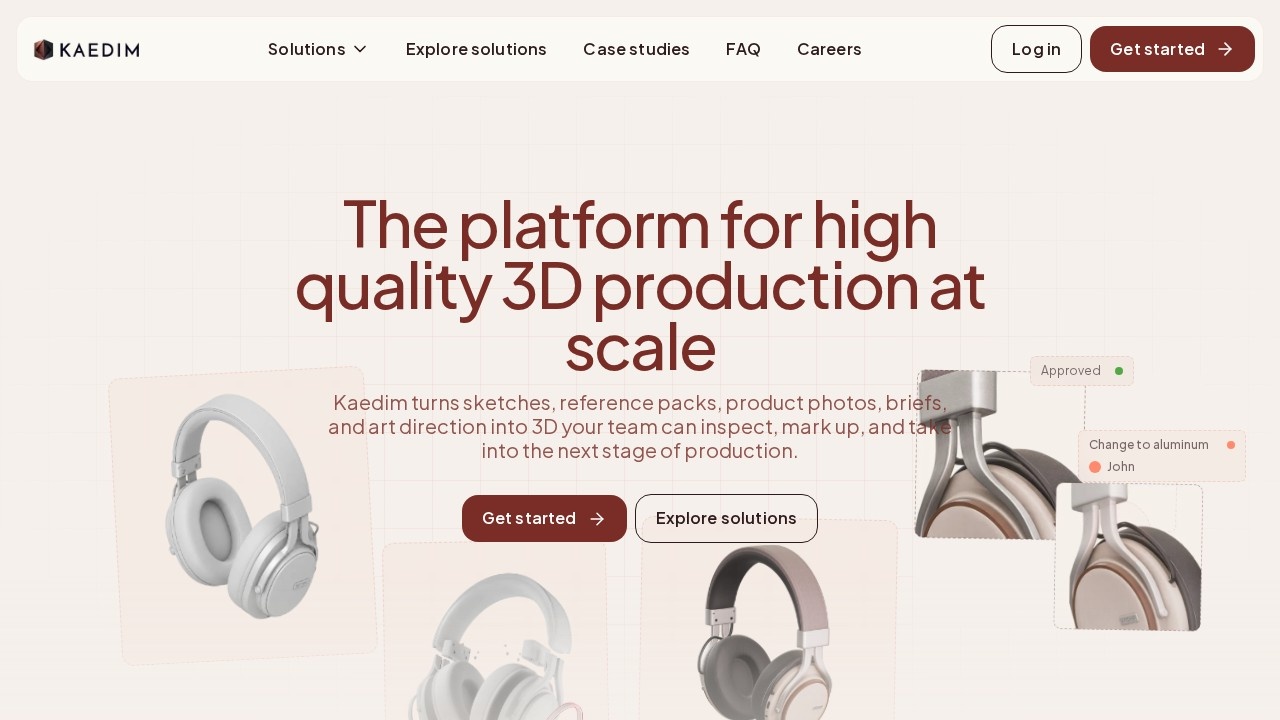
Kaedim is an AI-powered 3D asset production platform for studios and brands. It turns sketches, reference packs, product photos, briefs and art direction into 3D assets that your team can inspect, mark up and take into the next stage of production. The company says it can reduce 3D asset costs by up to 90 percent, which is its own estimate.
The problem
Kaedim's pitch is that 3D work often starts too late: the brief is locked and the campaign is moving, but the 3D is waiting for bandwidth, vendors or an overloaded artist. The platform aims to let teams scale 3D pipelines without hiring and bring 3D in while it can still influence decisions.
Use cases
For product design, it turns sketches, concepts and references into 3D before CAD begins, so proportion, volume and form can be resolved while they are easy to change. For games, Kaedim ingests art bibles, specification documents and reference packs to create props, environments and characters in your style for pre-production, production and live-service games. For e-commerce and marketing, it creates reusable product CGI for product pages, campaigns and launch pages without a photo shoot.
How work is reviewed
The site shows a review workflow where team members add comments such as material changes and approve assets, much like a design review. Production stages include creating surfaces, aligning geometry, selecting materials and adding polish. Kaedim describes itself as both a platform and a 3D asset creation service, so check how much of the output involves human artists as well as AI.
Pricing
Pricing is not listed on the main page. You get started or talk to the team and share your brief and references to receive a proposal.
Who it suits
Kaedim suits game studios needing many assets, consumer product teams that want early 3D visualisation, and e-commerce brands that need product renders at scale.
Things to consider
Test with a few assets that represent your hardest cases, such as stylised characters or detailed products, and check topology, polygon counts, UVs and file formats against your pipeline requirements. Clarify ownership and licensing of the assets and how your confidential references are stored. Factor in turnaround times and revision rounds when planning production schedules.
Details
- Pricing
- Paid
- Release date
- 2025-12-13
- Last checked
- 4d ago
- Indexing
- index, follow
- Category
- Design
Suggest an edit
Sign in to suggest an edit.
Alternatives
 Rescape AIIt works well as a daily driver. Saved templates, recent history, and multiple output options mean the tool adapts to the way you actually work. If ai image generation tasks...
 Backflip AIIf ai marketing tasks are part of your routine, Backflip AI is worth testing against your own use cases. Their website, backflip.ai, has the full details. The feature set covers...
 APPLOREAPPLORE is an app icon inspiration library of 18,000+ real App Store and Google Play icons, browsable by color, style and category, with every past version kept when an app…
 Canva AICanva Magic Studio review (October 2026): Canva's AI design tools, Magic Write, Magic Edit, Magic Media, plans, AI usage limits, pros and cons.
 Mia PrmA few standout features include quick presets, template support, export in common formats, and the ability to keep recurring projects organized in one place. The design favors clarity over decoration....
 Microsoft DesignerMicrosoft Designer is a free AI design app for images, cards, invitations and social posts, with monthly AI credits and more credits on Microsoft 365 plans.
 Free Outline Image GeneratorFreelancers use it to keep client work moving, while in-house teams rely on it for consistent output across projects. Either way, the routine parts of ai image generation work get...
 Webo AIFreelancers use it to keep client work moving, while in-house teams rely on it for consistent output across projects. Either way, the routine parts of ai image generation work get...
 Patchwork TattoosPatchwork Tattoos is an AI tattoo and image generation tool for exploring patchwork tattoo ideas, sleeve inspiration, filler concepts, and design variations. Users can generate or remix visual tattoo concepts…
 MokkerCollaboration hooks are there too - simple ways to pass work between teammates without emailing files back and forth or losing track of versions. Mokker is a ai image generation...
 Visor AIPower users get deeper controls, while casual users can ignore them. The result is a tool that scales from quick one-off tasks to larger recurring workloads. The tool is free,...
 Remove TextIt is a practical choice for ai image generation work, and the honest way to evaluate it is to give it a spin. Start at remove-text.com for the latest information....