


Synthflow AI
You will find a free plan, making it easy to test the tool against your own needs first. The practical way to judge it is to use it. For anyone...
Sign in to rate this tool.
Overview
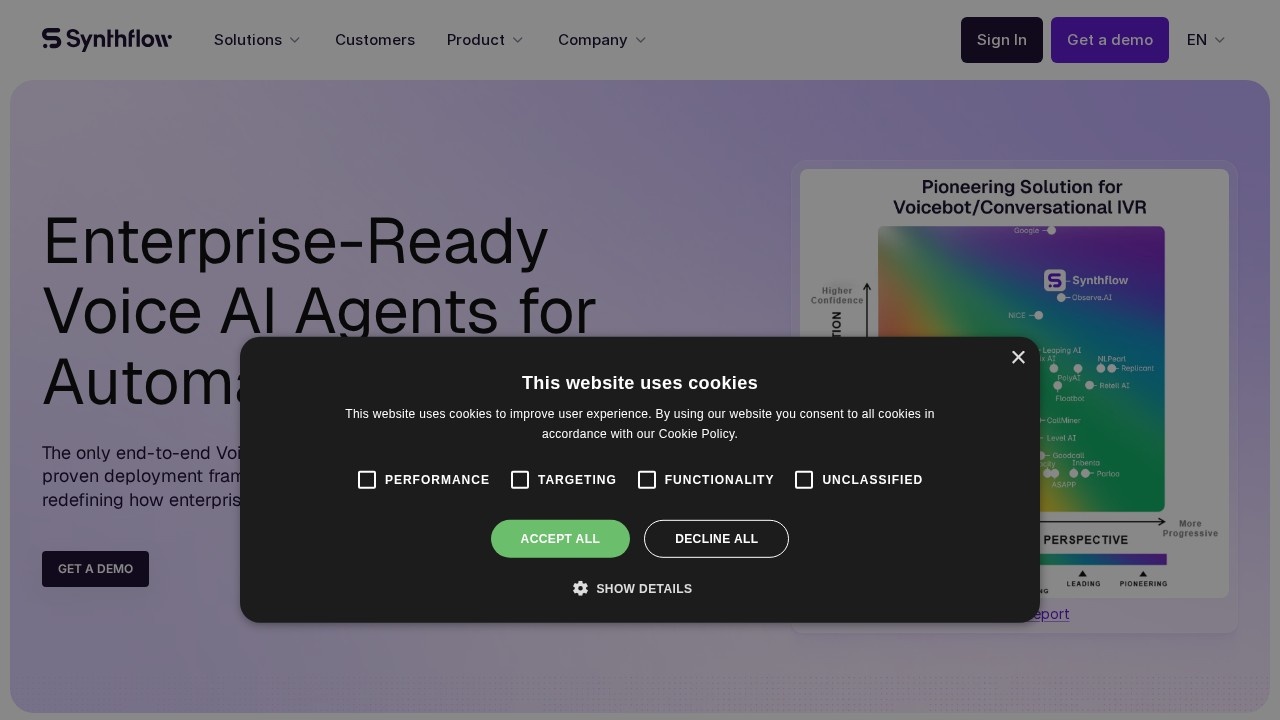
Synthflow is a voice AI platform that lets enterprises automate phone calls with AI voice agents. It describes itself as the only end-to-end voice AI platform with in-house telephony, a proven deployment framework and return on investment within weeks. Use cases include customer service, appointment scheduling, lead qualification and other high-volume call operations.
The BELL framework
Synthflow organises deployment into four stages: Build, Evaluate, Launch and Learn. In the Build stage, you use the visual Flow Designer to define every step of a call, connect APIs and create agents that follow business logic. In the Evaluate stage, the Test Center tests each agent automatically with simulated calls that measure accuracy, response quality and compliance against your KPIs before customers call. In the Launch stage, agents deploy through Synthflow's own telephony network; because Synthflow controls routing, latency and regional delivery, it says calls meet enterprise standards for reliability and speed. In the Learn stage, live performance is analysed to keep improving agents.
Scale
Synthflow says its platform has handled more than 500 million customer calls and saved over 4 million hours. It also claims 45% more answered calls, because agents respond instantly, and 99.99% uptime. It has more than 1,000 reviews on G2 with a 4.5 rating.
Pricing
Enterprise contracts start at $30,000 a year. Final pricing depends on call volume, concurrency, telephony setup, integrations, security needs and launch support. Contracts include enterprise SLAs and support terms, a choice of Synthflow native telephony, SIP trunking or approved enterprise telephony, custom concurrency planning, routing, escalation paths, handoffs and fallback logic, and integrations with CRM, calendar and contact centre systems. Contact sales or book a demo.
Who it suits
It suits enterprises and contact centres with large call volumes that want to automate routine calls while keeping human escalation.
Things to consider
Many places require callers to be told they are speaking to an AI, and outbound automated calls are regulated, for example under the TCPA in the US. Recording and transcribing calls needs consent in some regions. Plan clear handoffs to human agents for complaints and sensitive cases.
Because agents can connect to APIs during a call, they can look up orders, book appointments or update records rather than only reading a script.
Details
- Pricing
- Paid
- Release date
- 2026-04-02
- Last checked
- 4d ago
- Indexing
- index, follow
- Category
- Voice
Suggest an edit
Sign in to suggest an edit.
Alternatives
 Retell AIYou will find a free plan, making it easy to test the tool against your own needs first. The practical way to judge it is to use it. Students and...
 Hume AIEmpathic AI for voice and expression with emotional intelligence.
 Adola Voice Phone Number For Your AIIf ai marketing tasks are part of your routine, Adola Voice Phone Number For Your AI is worth testing against your own use cases. Their website, adola.ai, has the full...
 Autocalls AI AI Phone CommunicationsThe feature set covers the basics well and adds thoughtful extras - keyboard shortcuts, reusable templates, and clean sharing options - without overwhelming you. Before you decide, skip the speculation...
 ElevenLabsElevenLabs review (October 2026): AI voice generation, voice cloning, dubbing and speech-to-text, verified plan prices from Free to Business.
 Voicv Voice CloningAI-powered voice cloning, text-to-speech, and speech-to-text platform.
 Talkatoo ComIt works well as a daily driver. Saved templates, recent history, and multiple output options mean the tool adapts to the way you actually work. You will find a free...
 ScriptmeAutomatic transcription and subtitle platform with AI-powered tools and multi-format support.
 Respond IoCollaboration hooks are there too - simple ways to pass work between teammates without emailing files back and forth or losing track of versions. It is a practical choice for...
 AI Profile For SlackPricing is free, and there is no pressure to commit before you have seen results in your own context. A few standout features include quick presets, template support, export in...
 CursorCursor review (October 2026): AI-first code editor with agents, verified Hobby, Pro, Pro+, Ultra and Teams pricing, privacy mode, pros and cons.
 Api Governance TestingApi Governance Testing brings a fresh take on ai coding tools, pairing powerful AI with an interface that does not get in the way. It is aimed at everyday users...