


Earlyai
If ai agents tasks are part of your routine, Earlyai is worth testing against your own use cases. Their website, startearly.ai, has the full details. You will find a free...
Sign in to rate this tool.
Overview
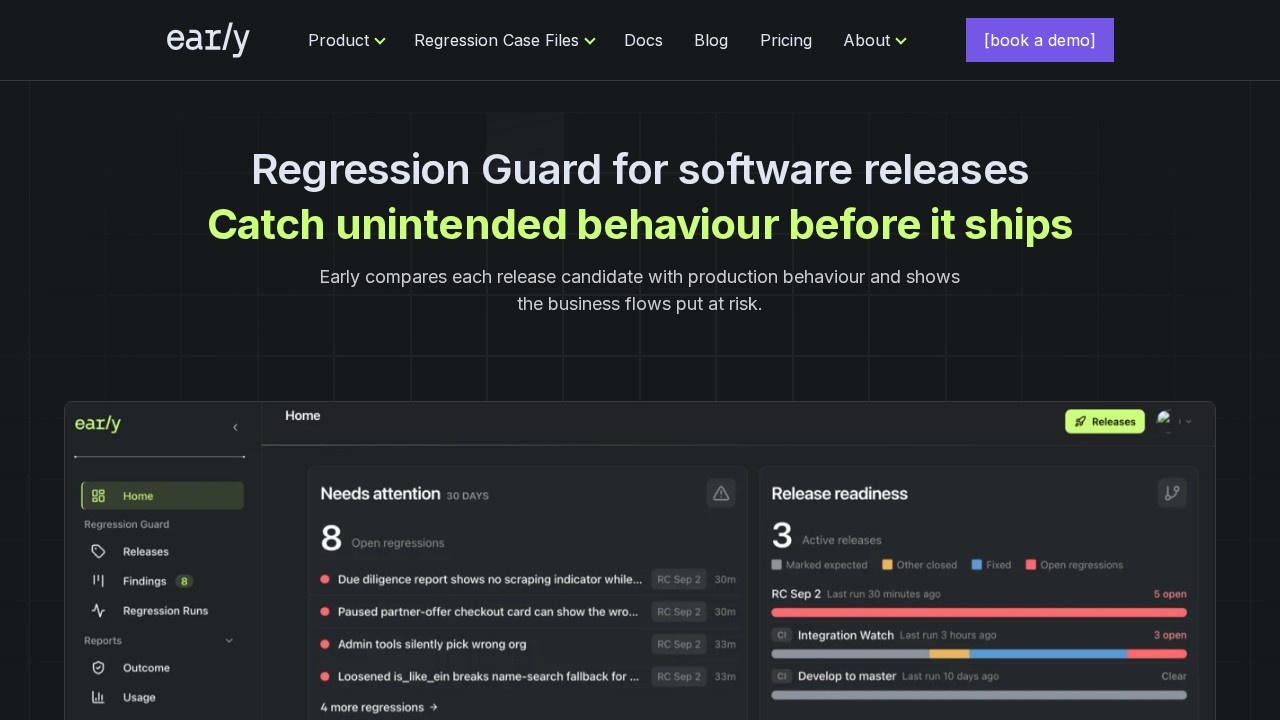
Early Release Guard, from Early AI (startearly.ai), is a tool for software teams that want to spend less time repairing bugs. It looks for bugs across configured projects and their dependencies, creates fix pull requests with tests for eligible findings, and shows evidence of what was analysed and verified. Engineers still review each change and decide whether to merge it.
Find, fix, know
The product is organised around three steps. Find covers spotting bugs as code changes. Fix covers generating a pull request that contains a proposed repair and added tests, which QA can start and engineering can review. Know covers reporting: a view of what was analysed, what was verified, what was resolved and what still needs attention, aimed at QA leads and release managers deciding what ships.
Bug case files
The site publishes case files of documented regressions that Early found in historical replays of open-source projects, including Mastra, Pydantic AI, Rspack, Conan and Hono. Each case notes how many releases the bug survived and how long it took to fix. This gives a concrete view of the kinds of problems the tool is designed to catch.
Research claims
Early also shares a study it sponsored of four open-source projects, which estimates that a large share of development effort went to repairs. The company notes that effort was estimated in story points rather than measured hours. As with any vendor-sponsored research, read the method before relying on the numbers.
Who it suits
Release Guard suits engineering and QA teams with active codebases who want automated help moving from bug reports to reviewed fixes. It is aimed at teams, with Team and Enterprise plans; the Team plan is a defined package that includes up to 20 configured projects.
Things to consider
Pricing is plan-based, so check the pricing page and book a demo to understand costs for your number of projects. Review how the tool accesses your repositories and what code leaves your environment. Treat generated fixes like any other contribution: run your full test suite and read each change carefully, since an automated fix can pass its own new tests and still miss the wider intent. Track how many proposed fixes are merged unchanged during a trial; that gives a clearer measure of value than headline figures.
Details
- Pricing
- Paid
- Release date
- 2025-06-27
- Last checked
- 3d ago
- Indexing
- index, follow
- Category
- Code
Suggest an edit
Sign in to suggest an edit.
Alternatives
 Kilo AIUnderneath it all, the processing is efficient enough for everyday use. Large inputs take a moment, but ordinary work flows through without interruption. Kilo AI brings a fresh take on...
 Webo AIFreelancers use it to keep client work moving, while in-house teams rely on it for consistent output across projects. Either way, the routine parts of ai image generation work get...
 Synthflow AIYou will find a free plan, making it easy to test the tool against your own needs first. The practical way to judge it is to use it. For anyone...
 ImagekitIf ai coding tasks are part of your routine, Imagekit is worth testing against your own use cases. Their website, imagekit.io, has the full details. It runs on a free...
 AI Assisted Contember StudioThe tool may appeal to individuals and teams looking for help with ai coding work,...
 WarpWarp pairs a modern terminal with coding agents and cloud agent fleets, with usage included at API rates on its Build, Max and Business plans.
 CosineCosine brings a fresh take on ai coding tools, pairing powerful AI with an interface that does not get in the way. It is aimed at everyday users and professionals...
 Veryfi ComIf ai coding tasks are part of your routine, Veryfi Com is worth testing against your own use cases. Their website, veryfi.com, has the full details. Small operations appreciate the...
 CursorCursor review (October 2026): AI-first code editor with agents, verified Hobby, Pro, Pro+, Ultra and Teams pricing, privacy mode, pros and cons.
 Applitools EyesIt runs on a free model, so getting started is a low-risk decision. After a few sessions you will know quickly whether it fits. Applitools Eyes brings a fresh take...
 Qdrant IoThere is a deliberate calm to how Qdrant Io works. Loading screens are short, buttons do what they say, and your work is saved where you expect it to be....
 Respond IoCollaboration hooks are there too - simple ways to pass work between teammates without emailing files back and forth or losing track of versions. It is a practical choice for...