


Depix AI
The tool is free, which keeps the barrier to entry low. You can try it before deciding whether it earns a permanent place in your workflow. What stands out most...
Sign in to rate this tool.
Overview
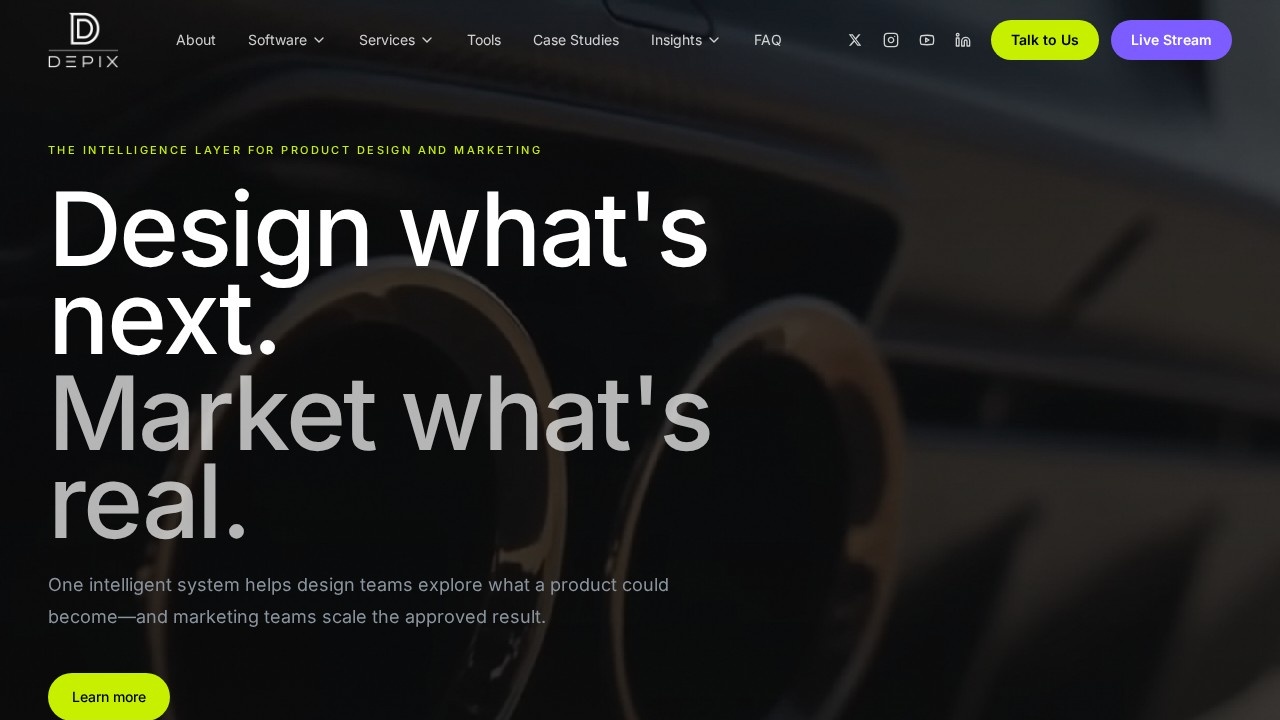
Depix calls itself the intelligence layer for product design and marketing. It is an AI-native platform for industrial designers and product teams that helps design teams explore what a product could become, and helps marketing teams create imagery of the approved result. The company says it is trusted by enterprise design studios.
For design
When a product is still in concept development, Depix lets designers explore shape, proportion, components and CMF, meaning colour, material and finish, through controlled change. The site shows three deliberate directions generated from one concept, such as a minimal light ribbon, a floating graphic and an off-road stance. Its meta description mentions AI agents, CMF Vision, Video Lab and an infinite canvas, and the path from concept to photorealistic 3D render in minutes.
For marketing
Once a product is approved, Depix creates new campaign scenes while the product stays unmistakably itself. The principle is to change what should change and lock what must stay: the background, light and setting can move, while the product remains accurate. Examples include the same product in glacial, desert and night street scenes.
Consistency checks
Depix stresses that consistency is a check every image must pass before anyone outside the studio sees it. It compares proportion against the real product and checks physical plausibility. Its stated principles are human-led direction, product-true identity and decisions turned into reusable intelligence.
Who it suits
Depix suits industrial design studios, consumer product companies and automotive or hardware brands that need many accurate product images for exploration and campaigns.
Things to consider
Pricing is not shown publicly, so contact the company for enterprise terms. Even with consistency checks, have designers and product managers approve final images, because small errors in proportions or details can mislead customers. Clarify how your unreleased product designs are stored and protected, since concept work is highly confidential. Starting with one decision, as the site suggests, such as a single concept exploration or one campaign, is a practical way to judge the results.
For teams that produce large numbers of product images for launches and campaigns, the promise of accurate, repeatable output is the main reason to evaluate it. A pilot on one product line keeps the test manageable.
Details
- Pricing
- Paid
- Release date
- 2025-11-15
- Last checked
- 5d ago
- Indexing
- index, follow
- Category
- Design
Suggest an edit
Sign in to suggest an edit.
Alternatives
 HuehiveThe tool is free, which keeps the barrier to entry low. You can try it before deciding whether it earns a permanent place in your workflow. Built for ai analytics...
 The New BlackBefore you decide, skip the speculation and look at the source. thenewblack.ai shows exactly what The New Black does today and how to get started with it. Plenty of detail...
 KittlKittl is an AI-first design platform for merch, packaging, logos and ads, with AI image, vector and video tools, mockups and commercial licences on paid plans.
 Backflip AIIf ai marketing tasks are part of your routine, Backflip AI is worth testing against your own use cases. Their website, backflip.ai, has the full details. The feature set covers...
 Image PipelineThe tool is free, which keeps the barrier to entry low. You can try it before deciding whether it earns a permanent place in your workflow. Before you decide, skip...
 Tensor.ArtTensor.Art is a free online image generator and model hosting site where you run community checkpoints and LoRAs or use guided tools like OC Creator.
 Rush Roto Product Photo A IWhat stands out most is predictability. The same input produces dependable output, which matters when you are producing work for clients or publishing on a schedule. It runs on a...
 RoamaroundIf ai research tasks take up too much of your day, Roamaround is built to give you time back. It handles the heavy lifting while leaving you in control. The...
 AvathYou will find a free plan, making it easy to test the tool against your own needs first. The practical way to judge it is to use it. What stands...
 Dyspute AIThe tool is free, which keeps the barrier to entry low. You can try it before deciding whether it earns a permanent place in your workflow. If ai image generation...
 Free Outline Image GeneratorFreelancers use it to keep client work moving, while in-house teams rely on it for consistent output across projects. Either way, the routine parts of ai image generation work get...
 WorkbotPower users get deeper controls, while casual users can ignore them. The result is a tool that scales from quick one-off tasks to larger recurring workloads. It is a practical...